Polish beef pot roast braised three hours: brisket or chuck, root vegetables and a thick gravy
A piece of beef rich in collagen, browned on every side and braised for three hours at 160 °C under a lid, until a fork slides in without resistance. The gravy makes itself from the vegetables and the juices; it only needs sieving and thickening. A Sunday dinner with under an hour of work, the rest of it happening in the oven.

Your own work in that: 55 min.
- Preparation 15 min
- Browning meat and vegetables 25 min
- Braising 180 min
- Resting 20 min
- Gravy 15 min
Step by step
0 / 7 done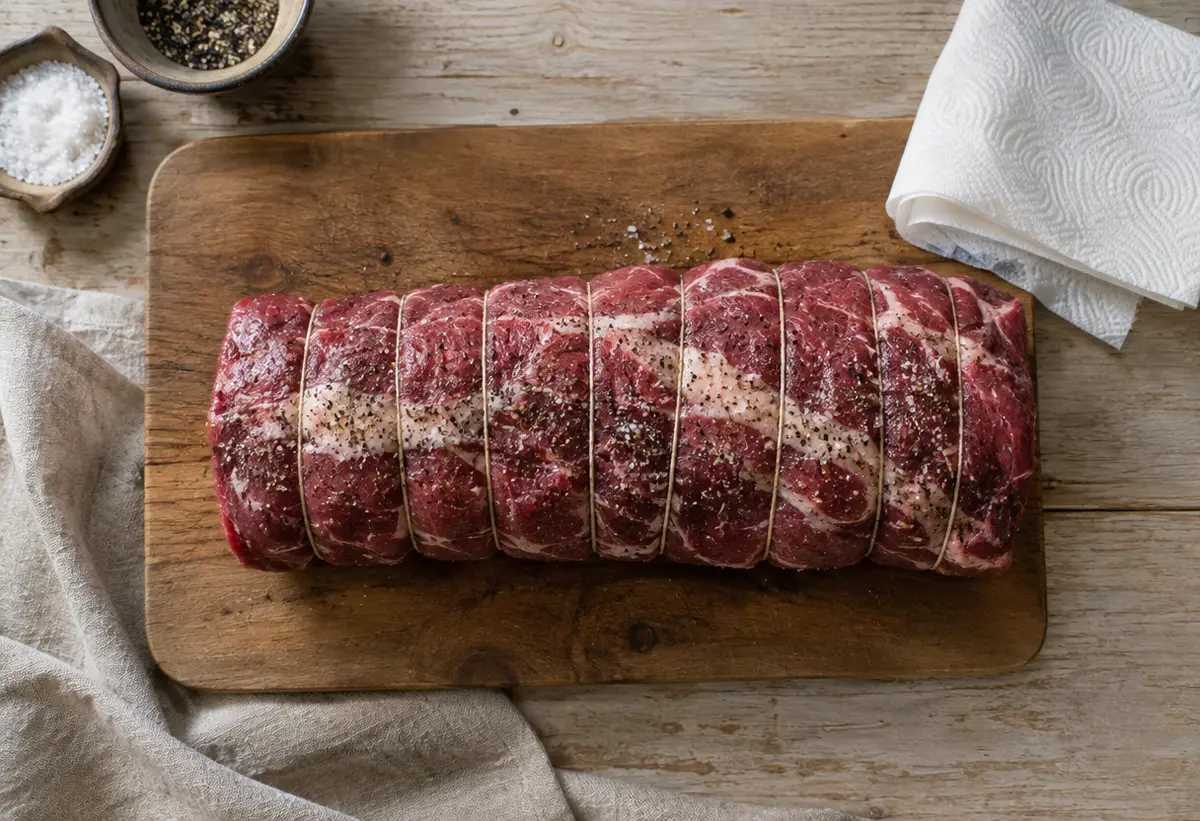
Dry, season and tie the meat
Take the beef out of the fridge an hour ahead. Pat it dry with paper towel on every side, rub with salt and pepper, then tie with kitchen string every 3 cm into an even cylinder. Heat the oven to 160 °C.
Ingredients: 1500 g beef: brisket, chuck or shoulder · 2 tsp salt · 1 tsp black pepper · 3 tbsp oil
TipTying is not decoration. An untied piece splays out during braising into loose strands of different thickness, so one part falls apart while another is still tough. An even cylinder cooks evenly and, after three hours, still carves into whole slices.
Dried, seasoned, tied every 3 cm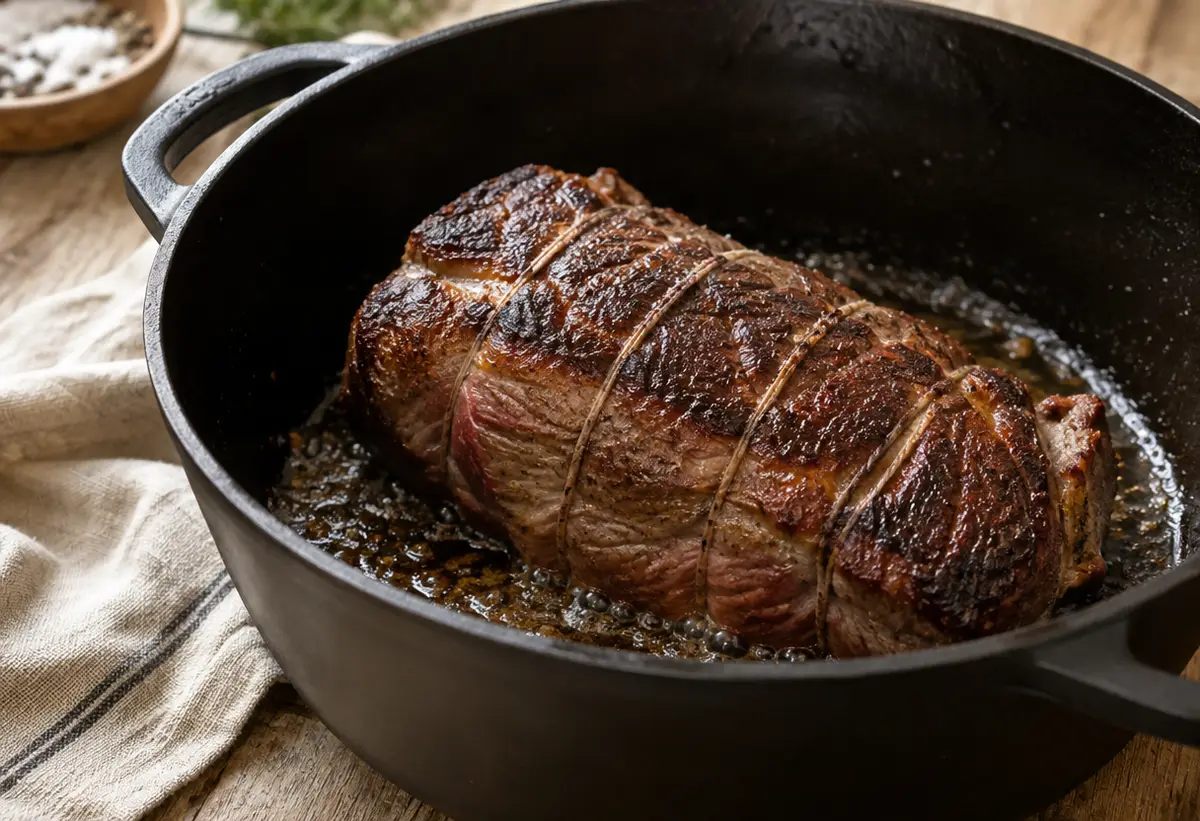
Brown on every side
Heat the oil hard in the pot, until it just begins to smoke. Put the meat in and sear 2–3 minutes on each side, without moving it in between, until a deep brown crust forms all over — about 15 minutes in all. Lift it out onto a plate.
TipThe crust does not 'seal in the juices' — it is the Maillard reaction, which needs a dry surface and about <b>140 °C</b>. The surface of wet meat cannot rise above 100 °C until the water has boiled off, and in that time it turns grey instead of browning. Hence the paper towel in the previous step.
Two to three minutes a side, nothing moved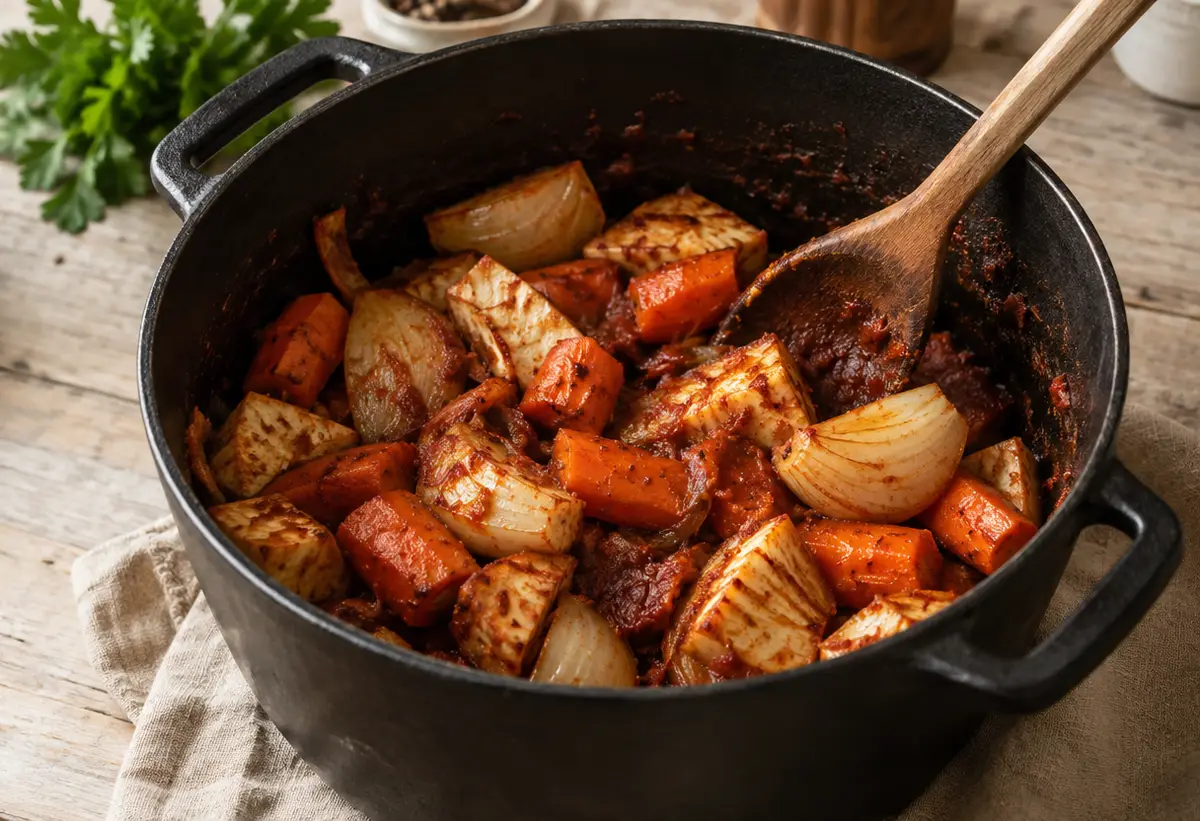
Fry the vegetables
In the same fat fry the quartered onions and the roughly cut carrot, parsley root and celeriac for 8 minutes, until the edges colour. Add the garlic and tomato paste and fry 2 minutes, stirring, until the paste darkens to brick red.
Ingredients: 2 pcs onions · 2 pcs carrots · 1 pcs parsley root · 150 g celeriac · 4 cloves garlic · 1 tbsp tomato paste · 700 ml beef stock · 3 pcs bay leaves · 5 pcs allspice berries · 8 pcs black peppercorns · 1 tsp marjoram or thyme
TipThe tomato paste has to be fried, not merely stirred in. Raw, it leaves a sour, tinny note in the gravy; those two minutes in hot fat drive off its water and toast its sugars, so the flavour turns deeper and sweeter.
Vegetables golden, paste turned brick red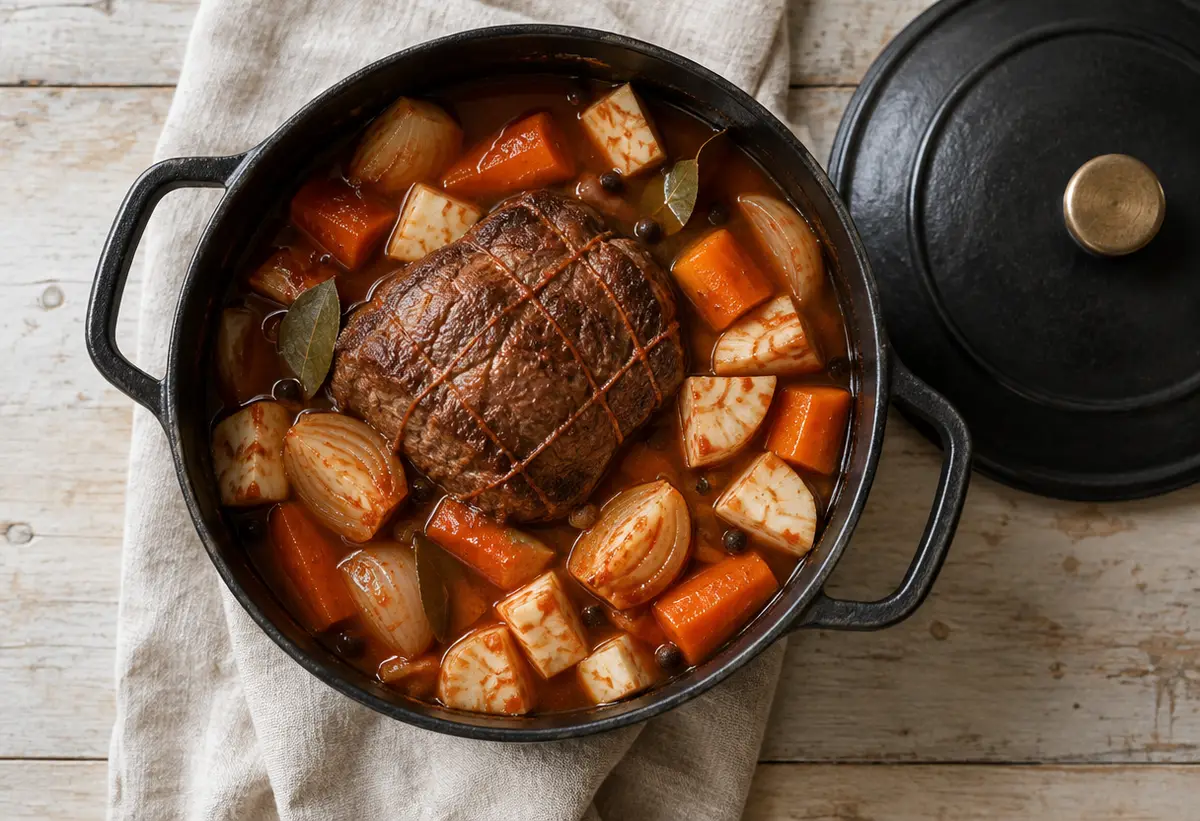
Braise for three hours
Return the meat, pour in hot stock to two-thirds of its height (do not submerge it), add the bay leaves, allspice, peppercorns and marjoram. Bring to the boil on the hob, cover and put it in the oven for 3 hours at 160 °C. Turn the meat over after an hour and a half.
TipYou tell it is done by the fork, not the clock: pushed into the thickest part it should go in and come out <b>with no resistance at all</b>, and the inside of the roast should then read <b>90–95 °C</b>. That is not a mistake — for tough cuts a high internal temperature is the goal: the closer to 90 °C, the faster collagen turns into the gelatin that makes the meat feel succulent. If the fork meets resistance, give it another 30 minutes and check again.
Stock to two-thirds, lid on, 160 °C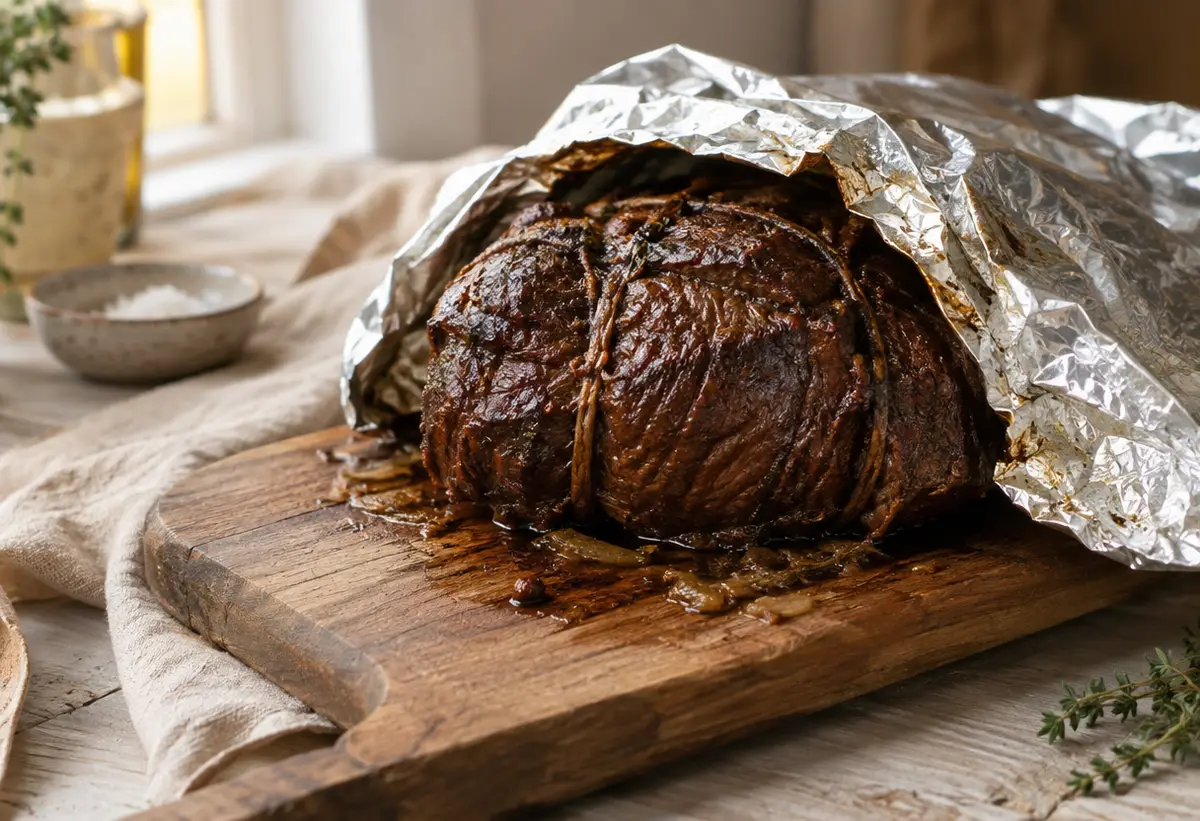
Lift out and rest 20 minutes
Move the meat to a board, tent it loosely with foil and leave 20 minutes. Do not carve sooner.
TipDuring braising the juices and dissolved gelatin are thin and mobile. As it rests they thicken and soak back into the meat; a roast carved straight away leaves much of it on the board and the slices come out dry.
Under foil, twenty minutes, no carving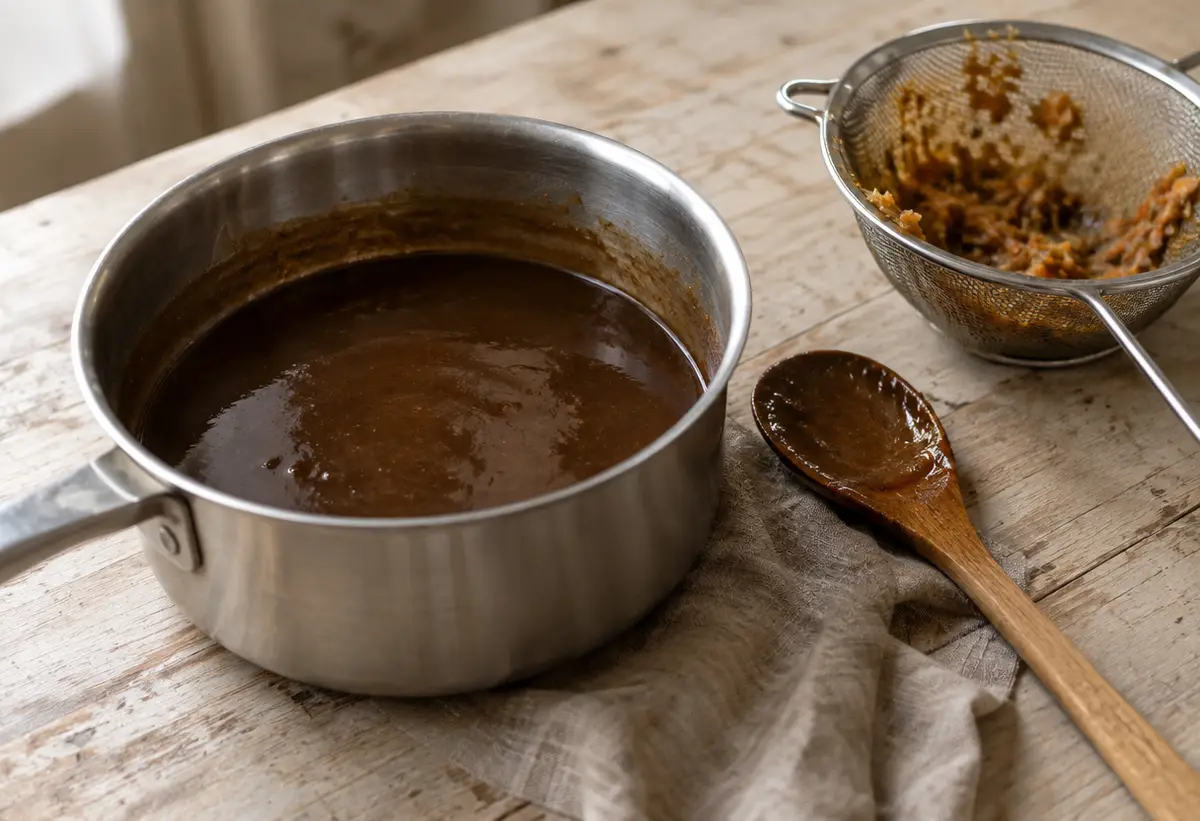
Make the gravy
Press the contents of the pot through a sieve into a saucepan, pushing the vegetables through with a spoon; discard the spices. Skim the excess fat off the surface. Mix the flour smoothly into the cold water and pour it into the boiling gravy in a thin stream, whisking. Cook 5 minutes, until it coats the back of a spoon. Season with salt and pepper.
Ingredients: 2 tbsp plain flour · 100 ml water · 1 tsp salt · ½ tsp black pepper
TipThe slurry must be made with cold water and must go into boiling gravy, not the other way round. In warm water the flour clumps while still in the cup, and poured into lukewarm gravy it tends to sink and catch on the bottom instead of thickening at once.
Pressed through a sieve, slurry into boiling liquid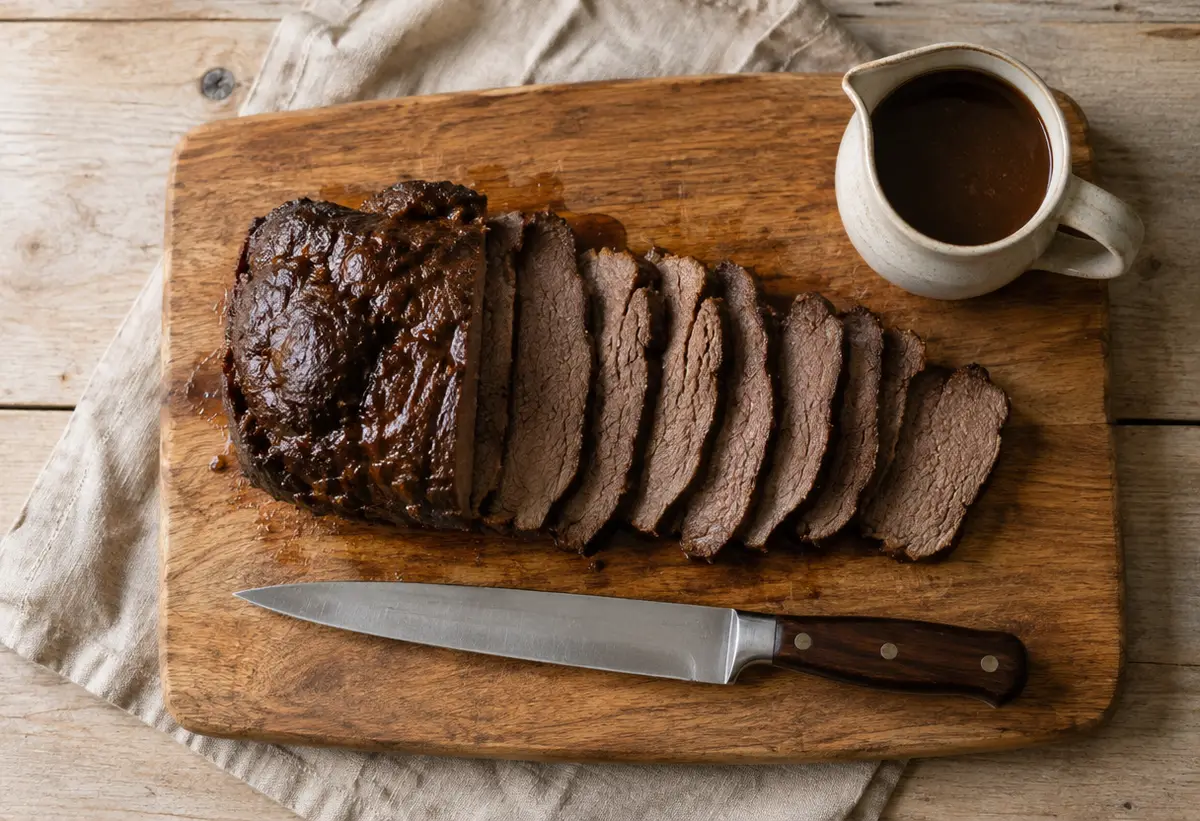
Carve across the grain and serve
Remove the string. Find the direction the muscle fibres run in and cut at right angles to them into 1 cm slices. Serve with the gravy, potatoes and beetroot, or with Silesian dumplings.
Ingredients: 1200 g potatoes · 500 g beetroot
TipMuscle fibres are long bundles you can bite through crosswise but not lengthwise. Cutting at right angles shortens them to a centimetre and lets the knife do work your teeth would otherwise have to do — the same piece of meat is then noticeably more tender.
At right angles to the grain, centimetre slices
Before you start
The day before
Braised a day ahead and chilled whole in its gravy, the roast carves into perfectly even slices because the gelatin has had time to set. Reheat the slices in the gravy, covered, 20 minutes at 150 °C.
With dried mushrooms
20 g dried porcini soaked in 200 ml water, added with the stock (soaking water too). The gravy comes out darker and deeper, closer to beef roulades.
The meat stayed tough
That almost never means it was braised too long — it means too short. Collagen needs several hours close to the boil. Put the pot back for 45 minutes and test with a fork again; the only tough roast is one taken out early, or a cut too lean to braise.
Nutrition
per 100 gStep photos are computer-generated from the recipe.


